Struggling with meal prep? Get my 20 Healthy Recipes for Mom & Baby for FREE!
Exercising With Your Baby: 10 Moves You Can Do Together
Disclosure: This post contains affiliate links. If you click through and make a purchase, I may receive a commission at no additional cost to you. I only recommend products I truly love and use.
No childcare, no equipment, no excuses — a joyful guide to movement that includes your baby, not works around them. The biggest barrier most new moms face isn't motivation. It isn't equipment. It's a baby who needs constant attention and a schedule that changes daily. What if the baby wasn't the obstacle — but the workout partner?
Baby-inclusive exercise is one of the most practical, joyful, and underrated approaches to postpartum fitness. Your baby gets stimulation, eye contact, movement, and your full attention. You get a workout, a mood boost, and a sense of reclaiming your body — all without needing a crèche, a babysitter, or a nap to align with your schedule.
This guide covers everything you need to know: when it's safe to start, how to do it safely at every stage, and ten specific exercises you can begin this week.
When is it safe to start?
This is the most important question — and the answer depends on how your birth went and how your recovery is progressing. There is no universal "cleared at 6 weeks" rule, despite what you may have heard.
As a general guide, most women can begin gentle postpartum exercise — walking, pelvic floor work, gentle stretching — within the first few weeks. More structured movement, including the exercises in this article, is generally appropriate from around 8–12 weeks for vaginal births and 12–16 weeks for C-sections, provided you have no ongoing symptoms such as pelvic pain, heaviness, or leaking.
Always get clearance from your GP, midwife, or pelvic floor physiotherapist before starting any structured postpartum exercise programme. The exercises in this article are designed to be gentle and low-impact, but your individual recovery is unique to you.
Safety at every baby stage
As your baby grows, what's safe and enjoyable changes significantly. Here's a quick guide to exercising together across the early months:
Important: Always get clearance from your GP or midwife before returning to exercise after birth. The traditional "6-week check" is a minimum, not a full green light — especially for C-section recovery or those with pelvic floor symptoms.
0 – 3 months
Newborn stage
Baby lies on a mat nearby or on your chest for gentle moves. No bouncing, no overhead holds. Focus on floor-based exercises with baby on a play mat in front of you.
3 – 6 months
Head developing
Baby can be held facing you with good head support. Gentle squats and lunges work well. Avoid any sudden movements or fast directional changes.
6 – 12 months
Sitting & crawling
Baby can sit independently and engage more actively. More interactive moves become possible. Baby may crawl away mid-exercise — embrace the chaos, it's all part of it.
Universal rule: Always support baby's head and neck fully until they have strong independent head control — usually around 4 months. Watch your baby's face throughout every exercise. If they look uncomfortable, unsettled, or distressed, stop immediately and tend to them. The workout can always resume.
Why this builds bonding as well as fitness
There is a beautiful bonus to exercising with your baby that goes beyond physical fitness. When you squat while holding your baby face-to-face, maintaining eye contact and talking or singing, you are delivering exactly the kind of stimulation that supports early brain development — responsiveness, connection, and joyful interaction.
Many moms report that baby-inclusive workouts feel less like exercise and more like play. The giggles, the eye contact, the way a baby lights up when you lower them during a squat — it transforms movement from a chore into a genuinely lovely part of the day. And a workout you enjoy is one you keep coming back to.
10 moves to do with your baby
These exercises require no equipment beyond your baby and a comfortable floor surface. A yoga mat is helpful but not essential. Work at your own pace — quality and comfort matter far more than speed or reps.
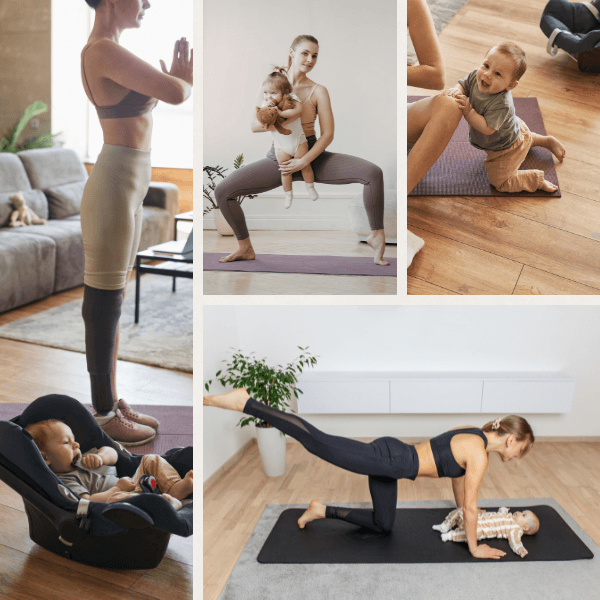
1.Baby squat
Lower bodyFull body
Stand with feet shoulder-width apart, holding baby securely against your chest facing you. Slowly lower into a squat, keeping chest tall and knees tracking over toes. Rise back up. 3 sets of 10–12 reps.
Baby experience: face-to-face eye contact, gentle up-and-down movement — most babies love this one.
2.Baby chest press
Upper bodyCore
Lie on your back with knees bent. Hold baby securely on your chest. Slowly press baby upward, extending arms, then lower gently back to chest. Keep core engaged throughout. 3 sets of 8–10 reps.
Baby experience: feels like flying — giggles almost guaranteed. Make eye contact and smile as you press up.
3.Glute bridge with baby on tummy
Lower bodyCore
Lie on your back, knees bent, baby resting on your lower tummy facing you. Press through your heels and lift your hips toward the ceiling, squeezing glutes at the top. Lower slowly. 3 sets of 12–15 reps.
Baby experience: tummy time in a new position — great for their core development too. Talk or sing to keep them engaged.
4.Standing lunge with baby
Lower bodyFull body
Hold baby securely against your chest. Step one foot forward into a lunge, lowering your back knee toward the floor. Push back to standing. Alternate legs. 3 sets of 8 each side. Only attempt once baby has good head control (4 months+).
Baby experience: gentle rhythmic movement, close to mom's heartbeat — often very calming for fussy babies.
5.Baby aeroplane (lying back extension)
Upper bodyFull body
Lie face down on your mat. Place baby on your back, or hold baby in front of you at chest level. Gently lift your chest off the floor, engaging your back muscles. Hold 2–3 seconds, lower. 3 sets of 8. Best for moms at 12+ weeks postpartum.
Baby experience: if on your back, they get a gentle ride — ensure they can hold their head independently before this variation.
6.Side-lying leg raise with baby
Lower bodyCore
Lie on your side with baby nestled safely in front of you. Keeping your body in a straight line, lift your top leg slowly to hip height, hold for 2 seconds, lower. 3 sets of 12 each side. Great for postpartum hip strengthening.
Baby experience: lying face-to-face with mom, close and calm — a lovely position for sleepy or newborn babies.
7.Standing march with baby
CardioCore
Hold baby facing outward, supported under their bottom. March on the spot, lifting knees to hip height, engaging your core with each lift. 3 sets of 30 seconds. Increase pace gradually as you get stronger.
Baby experience: facing the world, bouncy rhythm, great sensory stimulation. Add singing for extra joy.
8.Wall sit with baby on lap
Lower bodyCore
Slide your back down a wall until thighs are parallel to the floor. Sit baby on your thighs facing you, supporting them. Hold for 20–30 seconds, rest, repeat 3 times. Build duration as strength improves.
Baby experience: eye contact, face-to-face time — perfect for pulling silly faces and getting those first laughs.
9.Baby dance (active recovery)
CardioFull body
Hold baby securely and dance freely to one or two upbeat songs. Move your whole body — sway, step, turn gently. This counts as active recovery between harder sets and is genuinely good low-impact cardio. No rules. Just move and enjoy it.
Baby experience: pure joy. Music and movement together are among the richest early sensory experiences for babies.
10.Seated overhead press (older babies)
Upper bodyFull body
Sit cross-legged on your mat with strong posture. Hold baby securely at chest height. Slowly raise them overhead, arms fully extended, then lower. 3 sets of 8. Only appropriate once baby has full head control — typically from 5–6 months.
Baby experience: sees the world from up high — most babies find this thrilling. Watch their expression; if they seem unsure, lower immediately.
Important first step: Before starting, spend two weeks simply walking for 20–30 minutes daily. Walking is underrated as a foundational fitness tool — it builds the habit of movement and gently prepares your body for more structured exercise.
Your 20-minute routine
Here's how to combine these moves into a complete 20-minute session. You can mix and match based on your baby's age and mood — there's no perfect order, just movement that works for both of you.
20-minute mama & baby workout
3x per week · no equipment · all levels
Phase
Warm-up
Main
Main
Main
Main
Main
Cool-down
Exercise
Baby dance — move freely to 2 songs
Baby squat (move 01)
Glute bridge with baby (move 03)
Baby chest press (move 02)
Standing march (move 07)
Side-lying leg raise (move 06)
Gentle stretching on the mat with baby
Duration / Sets
5 minutes
3 × 10 reps
3 × 10 reps
3 × 10 reps
3 × 30 sec
3 × 10 reps
5 minutes
What to do when baby isn't cooperating?
It will happen. You'll be halfway through your squats, baby will decide they are absolutely done, and the session will end abruptly. This is normal, expected, and completely fine. Here's how to handle it without losing momentum or morale:
😢 Baby starts crying mid-session. Stop, tend to baby first — always. Once they're settled, see if you can continue. If not, even 10 minutes of movement counts. A partial workout is infinitely better than no workout.
😴 Baby falls asleep during the warm-up. Gently place them on their mat and continue with floor-based exercises nearby. This is actually a perfect scenario — you get the session, they get the nap.
🤸 Baby wants to crawl away and explore. Let them — and add a crawling chase into your cardio. Follow them on all fours, do a squat each time you pick them up, turn it into play. Flexibility is your superpower as a mom-athlete.
😠Baby simply isn't in the mood today. Put the workout aside without guilt. Try a solo session during nap time if one comes, or simply go for a walk together. Your consistency over weeks and months matters — one skipped session never does.
The best time of day to try this
Most moms find that the window 30–45 minutes after a feed works best — baby is content, not hungry, and not yet overtired. Morning sessions tend to be most consistent because the day hasn't yet filled up with the unexpected. That said, the best time is whatever time you can actually do it. Don't let the perfect schedule be the enemy of a good workout.
You don't need to choose between being present with your baby and taking care of your own body. These ten moves let you do both at once — and the bonus is that your baby will likely love every second of it. Start with two or three moves that feel accessible, build gradually, and let go of the idea that a "real" workout requires a gym, a babysitter, and an hour of free time. Twenty minutes, your baby, and a patch of floor is genuinely enough.
Hi! I’m Anna. I’m a proud mom of two beautiful girls and your guide on
this exciting journey
to a healthier, happier life. Everything I
publish here at here is designed
to inspire you to live your best life.
My mission is simple:
to empower women and busy
moms with practical tips on weight
loss, easy recipes, and the motivation
needed to balance a healthy lifestyle
with the joys (and chaos!)
of motherhood.
Written by: Anna Smith Johnson


Subscribe to our email list and unlock 20 FREE healthy recipes for mom & baby – designed to make mealtime easier and healthier.